Venkon DX
ceiling-mounted unit for heating or cooling with the natural refrigerant CO2
- Heating
- Cooling
- Ventilation
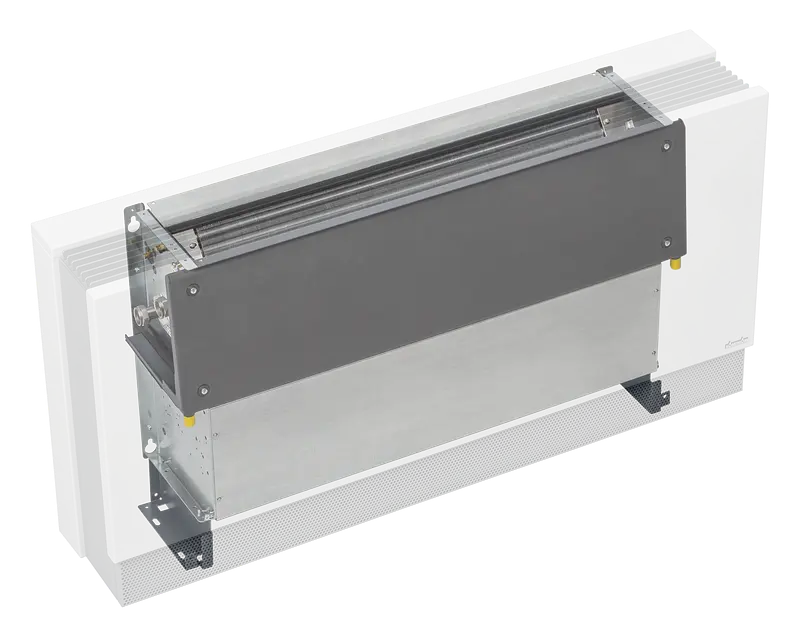
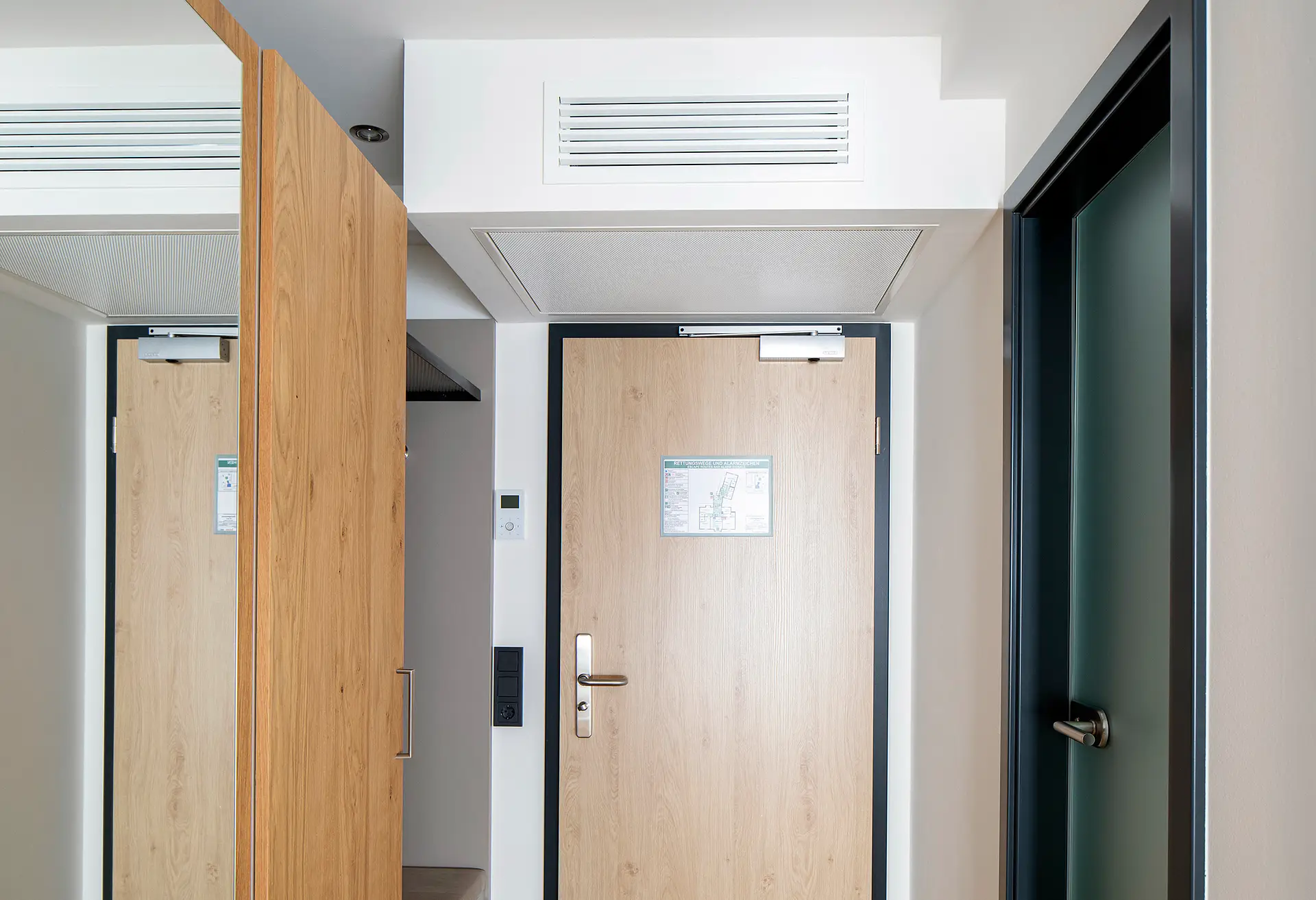
The units are available in several model sizes to allow the performance to be tailored to requirements. The model size is selected depending on the required thermal output, the air volume flow and the sound requirements of the room. Larger model sizes offer higher performance, but are associated with larger housing dimensions, which must be taken into account when planning the installation situation.
| Model size |
|---|
| 61 |
| 63 |
| 66 |
| 67 |
The installation location determines the basic structure of the unit.
The ceiling version has been specially developed for horizontal installation on the ceiling, with the air outlet facing forwards. The wall-mounted model, on the other hand, is designed for vertical installation on walls, with the air outlet facing upwards.
The two variants are not compatible with each other due to the design differences - particularly in the condensate tray and condensate drainage. Each version is specifically designed for fixing, condensate drainage and maintenance accessibility.
The selection of the right variant should therefore always be based on the structural conditions and maintenance requirements.
| Installation site |
|---|
| Ceiling-mounted |
| Wall-mounted |
Depending on the structural conditions and installation requirements, two connection variants can be selected:
Left or right connection.
These variants enable optimum adaptation to the pipe routing on site and reduce both installation work and costs.
The connection side is defined from the perspective of the mounted unit.
| Refrigerant connection |
|---|
| left |
| right |
Different filter types are available depending on the application area and the air quality requirements.
The standard version with an ISO Coarse filter primarily serves to protect the device by retaining coarse particles such as dust and fibers.
For applications with increased demands on indoor air quality, more powerful filters in accordance with ISO ePM, MERV or HEPA can be integrated as an option. These improve the indoor air by removing fine particles and aerosols from the intake air.
The suitable filter should be selected taking into account the project-specific requirements and the planned maintenance intervals.
| Filter class |
|---|
| Filter ePM1>50% (F7) |
| Filter ePM10>50% (M5) |
| ISO Coarse filter |
We offer various solutions for the control and regulation of our units, which can be used depending on the application and requirements:
Electromechanical control
This variant is ideal for simple applications. All integrated actuators are factory-wired to terminals and can be connected to our electromechanical accessories such as thermostats or external controllers.
| Control option |
|---|
| electromechanical with fault signal contact |
| electromechanical without fault signal contact |
Avoid the following:
The following must be observed when operating the unit below the dew point:
Results per page
Results per page
Page 1 of 0
Results per page
Results per page
Page 1 of 0